The 2026 SQA Higher Mathematics course report, published on Qualifications Scotland’s website on 10 September, gives several good clues as to how to gain your best possible grade. Strikingly, many of them have little to do with learning more mathematics; rather, they concern how clearly and accurately you communicate your solutions to problems.
The report reinforces something that experienced teachers and tutors see regularly: candidates do not necessarily lose marks because they have no idea how to tackle a question. Quite often they lose them through insecure basic skills, unclear working, small algebraic errors, or failing to check whether an answer is reasonable.
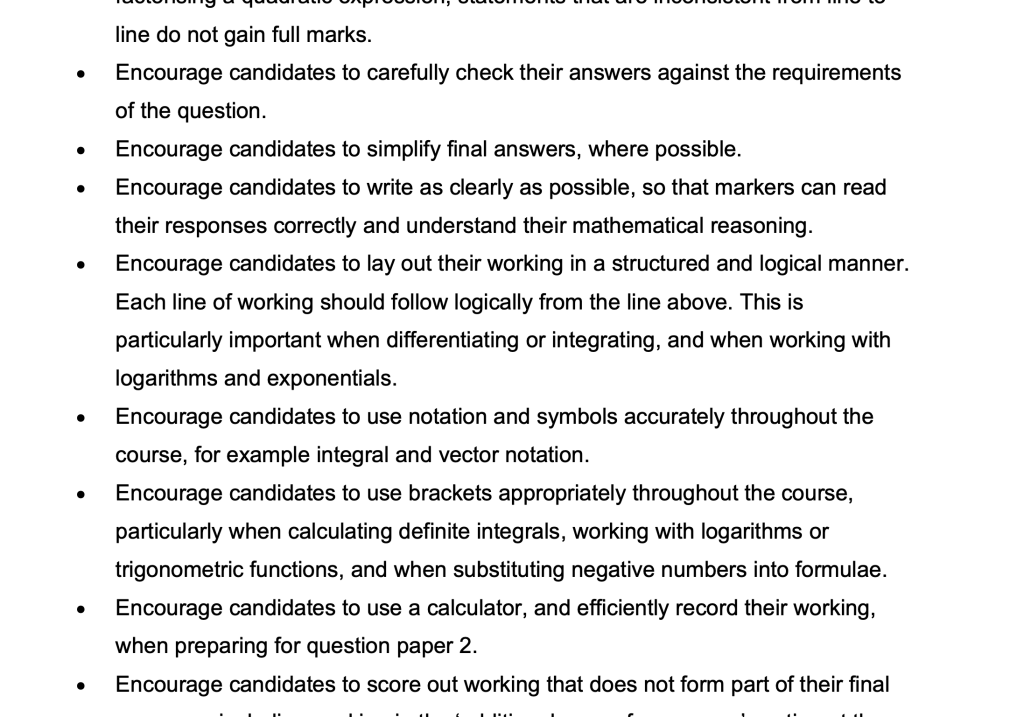
For Higher Maths pupils, there are four areas in particular which are worth paying attention to.
- Securing routine skills
- Seeing connections between topics
- Making your working easy to follow
- Developing the habit of micro-checking
1. Securing routine skills
A large proportion of the Higher course consists of techniques which should eventually become dependable: solving equations, manipulating algebraic expressions, differentiating and integrating standard functions, working with trigonometric identities, logarithms, vectors and so on.
These are sometimes thought of as the less interesting parts of the course, but they matter enormously. A candidate who is uncertain about basic algebra can lose marks even when they understand the more advanced idea behind the question.
This is one reason why regular practice of straightforward questions remains valuable. It is not simply repetition for its own sake. The aim is to make the basic techniques sufficiently secure that they do not get in the way when a more demanding problem appears.
2. Seeing connections between topics
Higher Maths is not really a collection of unrelated chapters. Many of the more demanding questions depend on recognising a familiar idea in a slightly unfamiliar setting.
A question may look like geometry but ultimately require algebra. A problem involving a graph may depend on understanding differentiation. A trigonometric question may become much simpler after an algebraic rearrangement.
One of the important steps in progressing beyond routine questions is therefore learning to ask:
What mathematical idea is this question actually testing?
This becomes increasingly important in the later questions of the paper, where the method is not always signposted.
3. Making your working easy to follow
Mathematics is not only about obtaining the correct final answer. Examiners award marks for mathematical reasoning, and that reasoning has to be visible.
Good working does not mean writing every tiny arithmetic step. It means showing enough of the structure of the argument that a marker can see what has been done and why.
For example, if an equation is being solved, the important algebraic stages should be visible. If a result is obtained from differentiation, the derivative should normally be shown. If a formula is being used, substitution into it should be clear.
Clear layout also helps the candidate. Well-organised working makes it much easier to spot an error and much less likely that one line of mathematics will become confused with another.
4. Developing the habit of micro-checking
Some marks are lost through very small errors: a missing minus sign, an incorrect power, copying a number wrongly, forgetting a constant of integration, or giving an answer which does not satisfy the original conditions of the problem.
These errors cannot always be eliminated, particularly under exam pressure, but candidates can reduce them considerably by developing a habit of frequent small checks.
Rather than waiting until the end of the paper and attempting to check everything, it is often more effective to check as the solution develops.
For example:
- Does the sign make sense?
- Has the expression been copied correctly?
- Is the answer of a reasonable size?
- Have all possible solutions been considered?
- Does the final answer actually answer the question asked?
These checks may take only a few seconds.
The broader lesson
The Higher Maths exam is certainly testing mathematical knowledge, but success also depends on how securely and carefully that knowledge is used.
A pupil who knows the course well but makes frequent algebraic slips, presents unclear working, or fails to check answers may perform below their mathematical ability. Conversely, improving these habits can produce a noticeable improvement in marks without learning any new topic at all.
In my Higher Maths tuition I emphasise two broad strands:
- practice, practice, practice
- get a feel for maths
In practice these develop into four habits:
- have strong ‘C’ grade skills (65% in the exam are ‘C’ grade level)
- get the big picture
- pay attention to layout
- commit to micro-checking
Those habits are useful well beyond Higher Maths, but the 2026 course report provides a timely reminder of just how important they are in the exam itself.
Please see my page on Higher Maths tuition for details of my tuition at this level.
